Which Asian Countries Have the Most Billionaires?
Mainland China has the most billionaires in Asia in Forbes’ 2026 country-and-territory breakdown, with 539, followed by India with 229. Forbes counts Hong Kong separately, with 71. These are annual-list figures based on citizenship, so they do not tell you how many billionaires physically live in each place. Source: Forbes
The leading Asian entries in Forbes’ latest annual breakdown
Forbes’ annual list provides a consistent snapshot for comparing countries. The entries below are the Asian places included in its published table of countries and territories ranked by billionaire citizens.
| Country or territory | Billionaires on Forbes’ 2026 list |
|---|---|
| Mainland China | 539 |
| India | 229 |
| Hong Kong | 71 |
| Taiwan | 66 |
Source: Forbes, “The Countries With The Most Billionaires,” 2026. This is a selection from Forbes’ global country table, rather than a complete inventory of Asian countries.
Forbes used stock prices and exchange rates from March 1, 2026. The figures therefore describe its annual snapshot, even when an individual’s wealth changes afterward. Source: Forbes’ annual-list methodology
For a worldwide comparison, see our countries with the most billionaires guide.
What the historical infographic shows
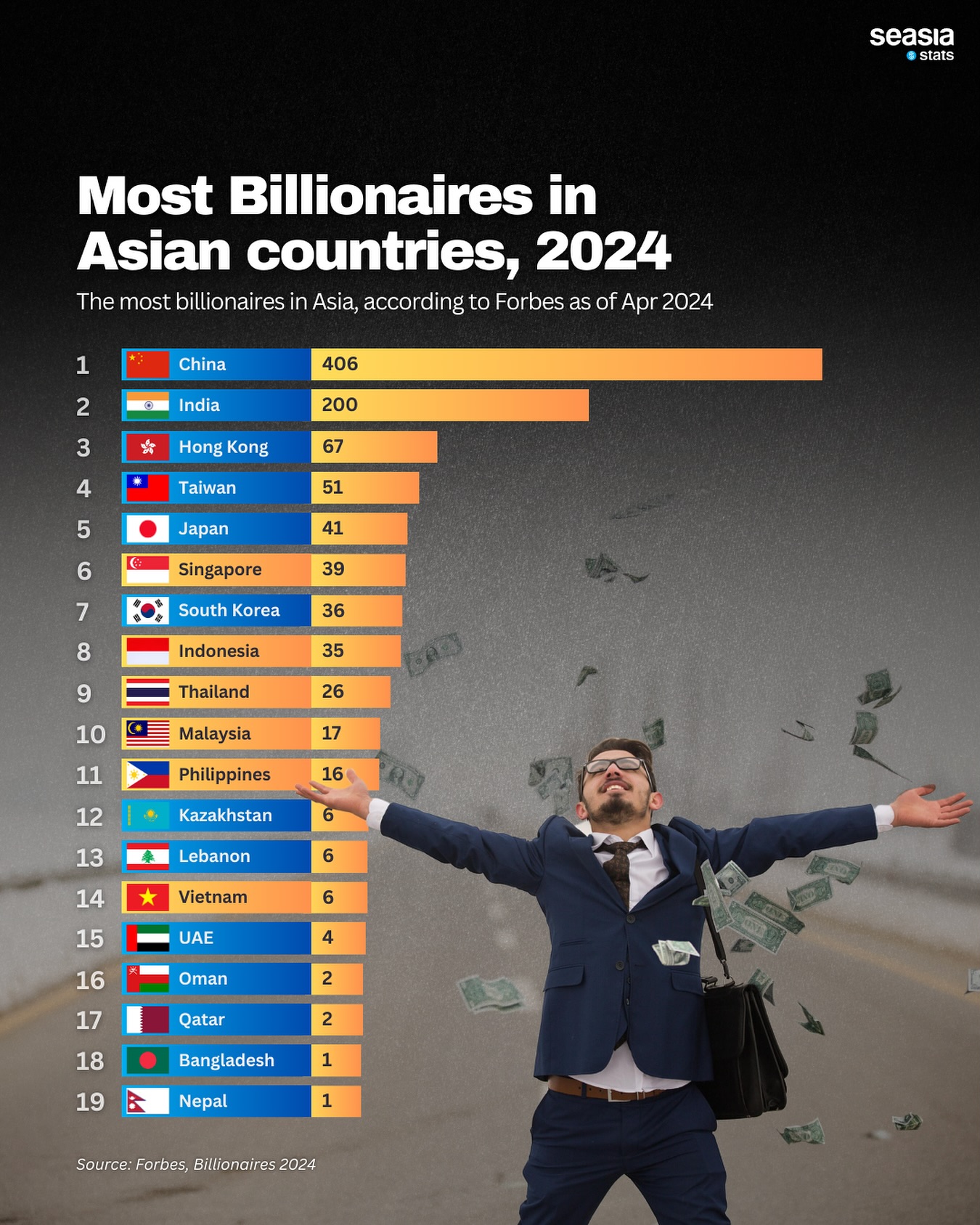
The Seasia infographic preserved on this page covers Forbes’ 2024 figures. It remains useful as a historical reference, provided its date stays attached to its numbers.
Here is a direct comparison for the leading entries that appear in both Forbes country articles:
| Country or territory | Forbes 2024 | Forbes 2026 |
|---|---|---|
| Mainland China | 406 | 539 |
| India | 200 | 229 |
| Hong Kong | 67 | 71 |
Sources: Forbes’ 2024 country breakdown and 2026 country breakdown.
The historical graphic also highlights Southeast Asia. Seasia reported Singapore with 39 billionaires, Indonesia with 35 and Thailand with 26, citing Forbes’ April 2024 data. Singapore led Southeast Asia in that snapshot. Those counts should always carry their historical date when quoted or shared. Source: Seasia Stats
A change in the count does not mean every additional person built a fortune during the intervening period. Because list membership depends on estimated wealth clearing the billionaire threshold, changes in business valuations and currencies can also affect who qualifies.
Citizenship and residence answer different questions
A citizenship ranking answers: Which country are these billionaires assigned to by the publisher? A residence ranking answers: Where do they live?
That distinction matters when comparing a large country with an international financial center. A billionaire can hold citizenship in one place, live in another and own businesses across several markets. Forbes’ country article explicitly describes its comparison as a count of billionaire citizens. Source: Forbes
Before using a count for research, check the underlying field:
- Citizenship: Useful for comparing the national affiliations assigned by the source.
- Residence: Useful for understanding where wealthy individuals are based.
- Business location: Useful for studying where their companies operate.
These fields are not interchangeable. A citizenship table alone cannot establish the size of a local investor community or the amount of capital available for a particular opportunity.
How Hong Kong and geographic boundaries affect the answer
Forbes lists Hong Kong separately from mainland China. Keep those entries separate when reproducing its comparison. Adding Hong Kong to mainland China creates a different grouping, which needs its own clear label.
“Asia” also needs a stated geographic scope. Russia spans Europe and Asia. Forbes counted Russian billionaire citizens on its 2026 list, but that national total does not identify how many live in Russia’s Asian territory. It should not be treated as an Asian-resident count. Source: Forbes
The same care applies when an Asia table includes or excludes other transcontinental countries or Western Asian markets. Check the coverage before interpreting a missing country as having no billionaires.
Why Forbes and Hurun give different totals
A figure can be correctly reported and still be unsuitable for comparison with another figure.
For example, Hurun reported 1,110 billionaires for China on its 2026 Global Rich List. Its wealth snapshot was dated January 15, 2026. Those figures belong to Hurun’s dataset and should not replace the China entry inside a Forbes table. Source: Hurun Australasia
The practical rule is straightforward: keep the publisher, valuation date and geographic definitions consistent. Do not assemble a ranking by taking each country’s largest available count from different reports.
For more context on why publishers’ totals differ, read how many billionaires there are in the world.
What the counts can tell a business owner
Billionaire counts offer a starting point for studying where large personal fortunes are associated. They cannot explain how those fortunes were built, how liquid they are or what their owners want to do next.
For that, study the underlying businesses and the owners’ decisions. In his Billionaires.com interview, Binod K. Chaudhary discusses the cost of pursuing a transaction too aggressively:
> “if you want a deal, very desperately, that’s when the beginning of the disaster starts”
That is a useful companion to a wealth ranking. The table gives you a count. An owner’s account can explain the judgment, operating choices and mistakes behind the wealth.
Sources
- Forbes: The Countries With The Most Billionaires, 2026
- Forbes: Annual World’s Billionaires List announcement and methodology, 2026
- Forbes: The Countries With The Most Billionaires, 2024
- Seasia Stats: Most Billionaires in Asian Countries, 2024
- Hurun Australasia: Hurun Global Rich List 2026
- Billionaires.com: Binod K. Chaudhary Interview