The Billionaire’s Brand Emporium: Who Owns Which Brands?
Billionaires are connected to familiar brands through personal holdings, family-controlled groups and stakes in public companies. Amazon owns Whole Foods Market, LVMH owns Tiffany & Co., and Berkshire Hathaway owns GEICO. Understanding those ownership chains explains much more than putting a billionaire’s face beside a company logo.
What does “owned by a billionaire” mean?
The phrase can describe very different relationships.
Personal ownership means a person holds a business directly or through a private holding company. Corporate ownership means the brand belongs to another company, whose shareholders include the billionaire. Voting control concerns the power to determine shareholder decisions, which can differ from the economic stake.
A founder is someone who helped establish a company. That description alone does not tell you their current ownership, voting power or operating role.
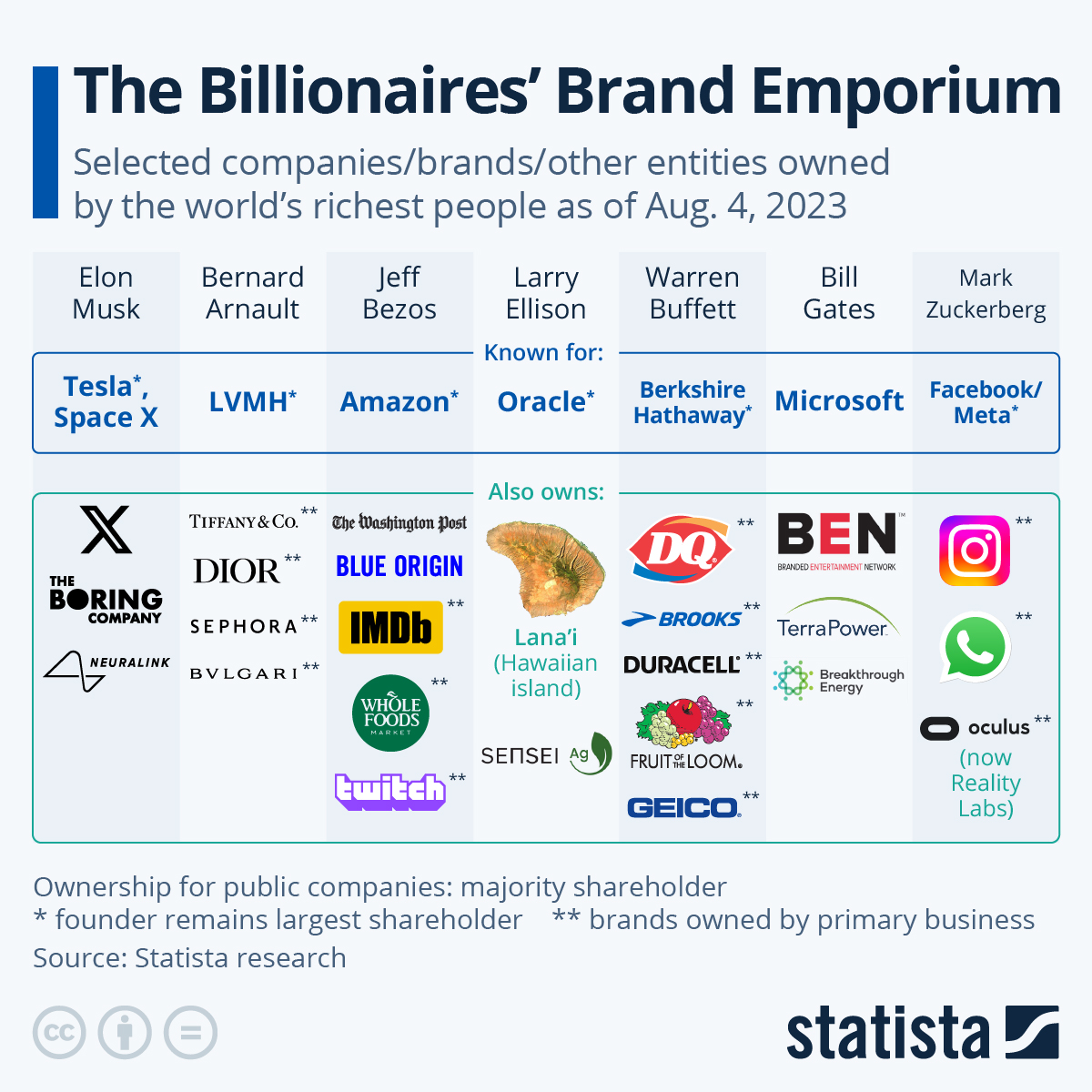
This distinction matters when reading the original Statista infographic below. Its ownership snapshot is dated August 4, 2023. It is a useful starting point for exploring the featured business empires, but its labels should not be treated as a live ownership register.
Familiar brands and the companies behind them
The table shows selected relationships behind the brands associated with the infographic’s best-known business figures. It distinguishes the company that owns or houses a business from the individual associated with it.
| Billionaire associated with the business | Parent company | Selected brands or businesses | How to read the relationship |
|---|---|---|---|
| Jeff Bezos | Amazon | Whole Foods Market, Twitch | These businesses sit within Amazon. They are distinct from Bezos’s personal holdings. |
| Bernard Arnault and family | LVMH | Tiffany & Co., Christian Dior Couture | The brands sit within LVMH, which the Arnault family controls through its corporate holdings. |
| Warren Buffett | Berkshire Hathaway | GEICO, Dairy Queen, Duracell, Brooks, Fruit of the Loom | Berkshire lists these businesses among its subsidiaries. They are corporate holdings rather than Buffett’s personal collection of brands. |
| Mark Zuckerberg | Meta Platforms | Facebook, Instagram, WhatsApp; Reality Labs | Meta houses the apps and reports Reality Labs as a business segment. Zuckerberg has voting control of Meta. |
Sources: Amazon’s 2024 Sustainability Report, LVMH’s Universal Registration Document, Christian Dior’s statement on Arnault family control, Berkshire’s subsidiary directory and Meta’s annual report.
Jeff Bezos: separate Amazon from personal holdings
The Washington Post belongs to Bezos through Nash Holdings, his private investment company. It is separate from Amazon. The Washington Post’s ownership report
That separation is the key to reading a Bezos business chart. A shared association with the founder does not make every business an Amazon subsidiary. Ask which entity actually holds the asset before drawing a connection between the businesses.
Bernard Arnault: distinguish the family, the group and the brand
Arnault’s connection to Tiffany and Dior runs through a family-controlled corporate structure. LVMH’s reporting identifies Tiffany & Co. and Christian Dior Couture within its businesses. Christian Dior SE’s statement describes the family’s controlling holdings in LVMH. LVMH reporting, Christian Dior SE statement
Also distinguish Christian Dior Couture, the fashion business, from Christian Dior SE, the holding company. Similar names can conceal very different functions in an ownership chart.
Warren Buffett: start with Berkshire
Berkshire’s own subsidiary directory places GEICO, Dairy Queen and the other businesses in the table inside the corporate group.
A subsidiary list also answers a different question from a stock portfolio. Owning shares in another public company does not automatically make that company a subsidiary. Keep operating businesses and investments separate when mapping a conglomerate.
Mark Zuckerberg: control differs from complete ownership
Meta’s 2025 annual report says Zuckerberg controls a majority of its voting power. The same filing places Facebook, Instagram and WhatsApp within Family of Apps, while Reality Labs covers virtual and augmented reality hardware, software and content. Meta annual report
Reality Labs therefore needs a different label from Instagram. It is a reporting segment, rather than simply another consumer brand. Zuckerberg’s voting control also does not mean he personally owns every Meta share.
Musk, Gates and Ellison: founding a venture is a different relationship
Some business empires consist of ventures connected through a founder rather than a single parent company.
Elon Musk: Tesla’s biography identifies Musk as a co-founder and leader of Tesla, SpaceX, Neuralink and The Boring Company. That establishes his connection to those ventures. It does not establish that Tesla owns the others, or that Musk owns each business outright. Tesla’s Musk biography
Bill Gates: TerraPower says Gates founded the company with a group of like-minded visionaries and identifies him as board chairman. The precise description is a founder and governance relationship. It should not be expanded into a claim of sole ownership. About TerraPower
Larry Ellison: Beyond Oracle, Ellison co-founded the Sensei wellbeing business with Dr. David Agus. Sensei’s founder page establishes that connection without specifying their ownership stakes. A founder biography is evidence of who built the business, but it cannot substitute for a shareholder record. Sensei’s founding story
These examples are selected relationships, not complete inventories of the individuals’ holdings.
How to check who owns a brand
Start with the brand’s official company information. Identify its legal business name and immediate parent, then follow the chain upward.
Use the document that answers your specific question:
- For corporate ownership: Look for subsidiary disclosures and completed acquisition announcements.
- For an individual’s stake: Read the company’s shareholder disclosures or proxy statement.
- For control: Check voting rights and share classes alongside economic ownership.
- For a private venture: State only what the available evidence establishes. A founder announcement does not reveal the full shareholder structure.
Check the reporting period and whether an announced transaction actually closed. A proposed acquisition describes an intended change. A completion announcement establishes that the change occurred.
This approach makes an ownership chart useful for understanding suppliers, competitors or potential business partners. It also prevents a familiar surname from replacing the actual corporate structure.
What business owners can learn from the brand emporium
A collection of logos shows breadth. It tells you little about customer loyalty, operating quality or why a business deserves to endure.
In his interview with Richard C. Wilson, John Paul DeJoria describes the product standard behind repeat purchases:
> “If enough people can just try it, I will get reorders, because I made the product so good.”
For an owner, that is a useful question to bring back to any brand portfolio: what makes the customer return?
Pair that question with a clear ownership map. Identify who owns the business, who controls decisions and who operates it. Then examine the product and customer relationship beneath the logo. For more on the wider wealth-building process, read how billionaires make their money.
Keep reading: how billionaires choose what to focus on · exclusive billionaire interviews · Richard Branson's brand expansion lessons
Sources
- Statista: The Billionaires’ Brand Emporium, original infographic
- Amazon: 2024 Sustainability Report
- LVMH: 2025 Universal Registration Document
- Christian Dior SE: Arnault family corporate structure statement
- Meta Platforms: 2025 annual report
- The Washington Post: Sale to Jeff Bezos
- Tesla: Elon Musk biography
- TerraPower: Company background and board
- Sensei: Founders and business background
- Billionaires.com: John Paul DeJoria interview