
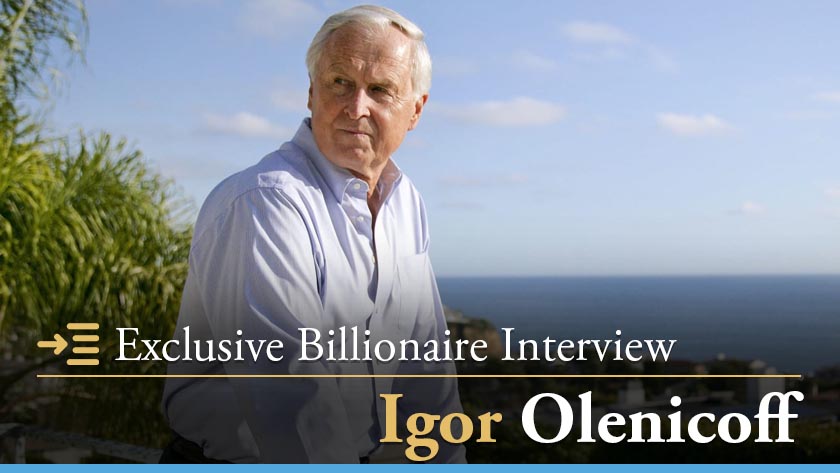
Igor Olenicoff
A billionaire real estate investor who owns over 100 flex industrial and office complexes and over 60 apartment complexes.
- Industry
- Real estate
- Country
- United States
- Format
- Written interview
- Interviewer
- Richard C. Wilson
- Source
- Forbes profile
About Igor Olenicoff
Igor Olenicoff is a billionaire real estate investor. He was born in the Soviet Union and moved to the United States at 15 years old. His family arrived as refugees on a ship into New York harbor with very little. He soon took a job stocking shelves at a builders hardware store, and kept it through high school and college. It taught him a lot about building materials and techniques, and it gave him an affinity for real estate. Every job he took after college leaned toward real estate. He bought his first 16 unit apartment building while in college and still owns it. His portfolio grew to over 100 flex industrial and office complexes of 8+ million square feet. It also includes over 60 institutional sized apartment complexes of 17,000+ units in 8 states.
The Interview
Exclusive Interview with Billionaire Igor Olenicoff
“One’s wealth continues to multiply if wise real estate investments are made”
Igor Olenicoff was born in the Soviet Union in 1942, and he moved to the United States when he was 15 years old. When he was 33 years old he bought a 16 unit multifamily (apartment building) asset, and starting to grow his investment platform. He grew into a 6.4 million in square foot of office space and over 12,000 residential units in various states around the U.S. The following is our exclusive interview recently completed with Igor:
- What was the major turning point, point of increased momentum, or strategic choke point, that once you acquired or completed, made everything you were doing surge forward?
My family, mom and dad, we arrived as refugees on a ship into NY harbor, with very little and the first night there we got a hotel room at an inexpensive hotel , happy to be there, went out to dinner and when we arrived back to the hotel we saw our suitcases had been broken and robbed of anything valuable we were able to bring. That set a real grim start and we knew even more so than before that it would take hard work and saving money to succeed . I was 15 years old and immediately got a job stocking shelves at a builders hardware store. I worked there all through high school and through college , which job thought we a lot about building materials and techniques , plus an affinity for real estate. All my jobs after college leaned towards real estate and what makes the industry tick. I studied who was successful, who was not and why to create a personal guiding light. It worked like magic.
- What is the most valuable strategy, worth far more than $1 million, that you wish someone provided you with early on that you can share here?
The most valuable strategy that frankly I did learn early on after arriving to the US was that it was then possible to borrow 90% of a real estate purchase. No other country in the world was that possible and then hearing , reading and seeing what long term benefits leverage and the long term holding of real estate means to wealth creation. Ones wealth continues to multiply if wise real estate investments are made and I still own the very first 16 unit apartment building I bought while in college and the very first 200,000 square foot project I built from the ground up 50 years ago. That strategy has led to owning over 100 flex industrial and office complexes of 8+ million square feet and over 60 institutional sized apartment complexes of 17,000+ units in 8 states.
- What is the #1 most costly mistake you have made, seen many investors make, or business owners make that could be avoided?
I learned the hard way that one should not rely on advice without thoroughly vetting that advice through other sources and ones own valuation . Just because someone works for a large institution, one has to realize that the advice they are providing is also influenced by that person’s “ personal benefit or gain “ criteria . I am not suggesting that fiduciaries or bank executives are not a good source of information , only suggesting that they have their own motivations wrapped into whatever they try to sell as advice or investment. Rely on yourself , study the matter carefully, realize that the theory they teach us in business school of the “win -win” concept is not reality. Everyone wants their side to win.
It is impossible to reduce ones life into 3 paragraphs , however I can summarize my life as having been extremely fortunate to land in the US, have the family, the many friends and opportunities that life presented. I also firmly believe and religiously practice what the really motivational writers suggested and books such as “ Think and Grow Rich” —– namely plan each of 5 -7 aspects of ones life in detail and update the plan periodically and follow the plan – you are certain to achieve your goals with mathematical certainty. Plan each aspect such as………. family , business, friends, personal growth and health , charitable, and other such parts of ones life which lead to a successful and happy life .
What They Shared in the Interview
In Their Words
“I was 15 years old and immediately got a job stocking shelves at a builders hardware store.”
“I studied who was successful, who was not and why to create a personal guiding light. It worked like magic.”
“One’s wealth continues to multiply if wise real estate investments are made.”
“Everyone wants their side to win.”
“I can summarize my life as having been extremely fortunate to land in the US, have the family, the many friends and opportunities that life presented.”
FAQs
How did Igor Olenicoff get started in real estate?
He worked at a builders hardware store through high school and college. The job taught him a lot about building materials and techniques. Every job he took after college leaned toward real estate.
What strategy does Igor Olenicoff call the most valuable?
He learned early that in the US it was possible to borrow 90% of a real estate purchase. Borrowing to buy real estate and holding it for the long term leads to wealth creation.
What does Igor Olenicoff own today?
He still owns the first 16 unit apartment building he bought in college, and the first 200,000 square foot project he built from the ground up. His portfolio includes over 100 flex industrial and office complexes of 8+ million square feet. It also includes over 60 apartment complexes of 17,000+ units in 8 states.

